

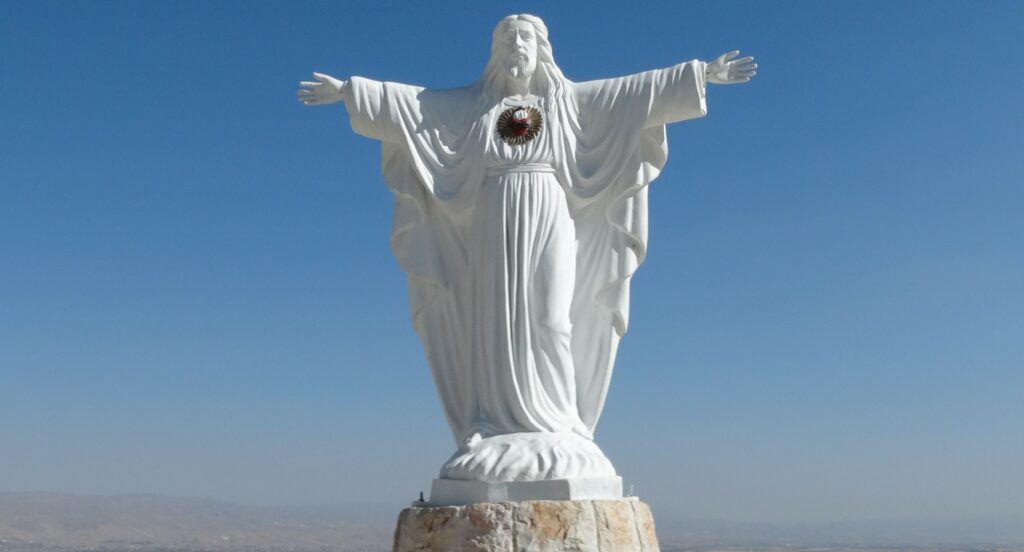
‘This is the day the Lord has made, let us rejoice in it and be glad.’
If I were a Christian in Iran or Gaza or Lebanon or Ukraine or in dozens of other places around the world, I would have found this Easter Sunday’s psalm difficult to pray.
How could anyone rejoice and be glad when faced with the reality of imminent death and destruction?
Yet as a statement of hope it rings as true as it ever was.
Humanity, or at least a certain section of it, refuses to learn the lessons of history and the same mistakes are repeated century after century.
During Lent, we have been hearing about all the things that led to the unjust condemnation and violent execution of Jesus.
The Roman authorities and many religious leaders, the rich and the powerful – the equivalent of some of our present-day political and religious leaders – felt threatened by all that Jesus preached and taught. His constant reference to the coming of a new Kingdom, God’s Kingdom, was more than they could bear. He described what kind of a Kingdom it would be, and upon what actions, or lack thereof, we would be judged on the Last Day.
How then did he describe the Kingdom?
It is a Kingdom where those who are starving are given food, and those who hunger for justice are fed with courage and perseverance.
It is a Kingdom where those who thirst, not just for water but for the meaning of life, find their thirst quenched by the life-giving waters of baptism that give birth to new life in God.
It is a Kingdom where innocent strangers are welcomed – not just tolerated, dismissed or imprisoned – and offered shelter and compassion, as brothers and sisters of the one human family.
It is a Kingdom within which the naked, the vulnerable, those who are humiliated and marginalised are clothed with dignity as children of a loving God, our brothers and sisters.
It is a Kingdom where the sick in mind or body or spirit are supported, loved and healed; where repentant sinners are offered mercy.
It is a Kingdom where prisoners in gaol are rehabilitated and helped to make reparation, and those imprisoned by sin, guilt and regret are forgiven and set free to start again.
The rich and powerful rejected all of this as words coming from someone who was deranged, a troublemaker, a blasphemer, possessed by the devil, a glutton and a drunkard.
In Holy Week, we were reminded of how this vilification and demonisation would inevitably be brought to a violent end.
On Palm Sunday, we saw Jesus enter Jerusalem in triumph. Surely, it was the poor, the homeless, beggars, outcasts and the curious who came out to welcome him. The rich and the powerful did not welcome him and were, in fact, plotting to be rid of him.
At the Last Supper, we sat with him as he told us he must suffer and die for us, giving us his body and blood as an eternal pledge of his real presence within us and among us. He washed the feet of his disciples and told us to wash the feet of our brothers and sisters, to love them and to serve each other with humility.
On Good Friday, we witnessed the all too familiar scenes of cruelty and degradation to which humanity can sink. Jesus was unjustly condemned to death, tortured, humiliated and left to die slowly on a cross; his body then laid in a borrowed, dark, stone-cold tomb.
His disciples scattered, disillusioned, distraught, despairing and broken.
Three days later, the mystery of the resurrection begins with an empty tomb. Soon the disciples realise that Jesus has conquered the old enemy, death, and triumphed over evil and the power of sin.
And we will see over the next few weeks, until Pentecost, how he showed himself to his disciples, commissioning them to go out to all nations to proclaim the coming of God’s Kingdom, the Kingdom for which he lived and died. It is the mystery of God who so loved the world that he gave his only son so that we might have life in abundance. This guides our lives as missionary disciples and fills us with hope especially in our present world of suffering, death and destruction.
For those political and religious leaders of today who gather to pray for violence without mercy against perceived enemies including the innocent; who pray for their total destruction; and to those who think they are gods, even likening themselves to our Saviour Jesus Christ, be aware that as Pope Leo preached on Palm Sunday, ‘Even though you make many prayers, I will not listen: your hands are full of blood’ (Isaiah 1:15).
‘Stability and peace are not built with mutual threats, nor with weapons, which sow destruction, pain and death, but only through a reasonable, authentic and responsible dialogue,’ Pope Leo said. ‘Jesus is the King of Peace, who rejects war, whom no one can use to justify war. He does not listen to the prayers of those who wage war but rejects them.’
Let us rejoice and be glad that by his resurrection Jesus Christ has conquered the old enemy and the power of some new enemies. Let us share the gifts of peace and joy, and life abundant and eternal.
He is Risen, Alleluia. May his Kingdom come.
I wish you a happy and blessed Eastertide,
Father Tony
In this month’s Mission Possible…
|
|

|

|
|

Sign up to our monthly eNewsletter |